The 5-Plant Starter List

Your kitchen counter could have three glass vases of thriving green plants by this weekend.

And you don't need a green thumb, a complicated routine, or another hour of Googling.

The 5-Plant Starter List is the one-page cheat sheet that tells you exactly which plants root fastest in water, what to put them in, and where to find beautiful glass that looks expensive — without paying HomeGoods prices.

No soil. No guesswork. No more quiet guilt about the plant you didn't mention when you threw it away.

Free. No spam. Unsubscribe anytime. We'll never share your email.

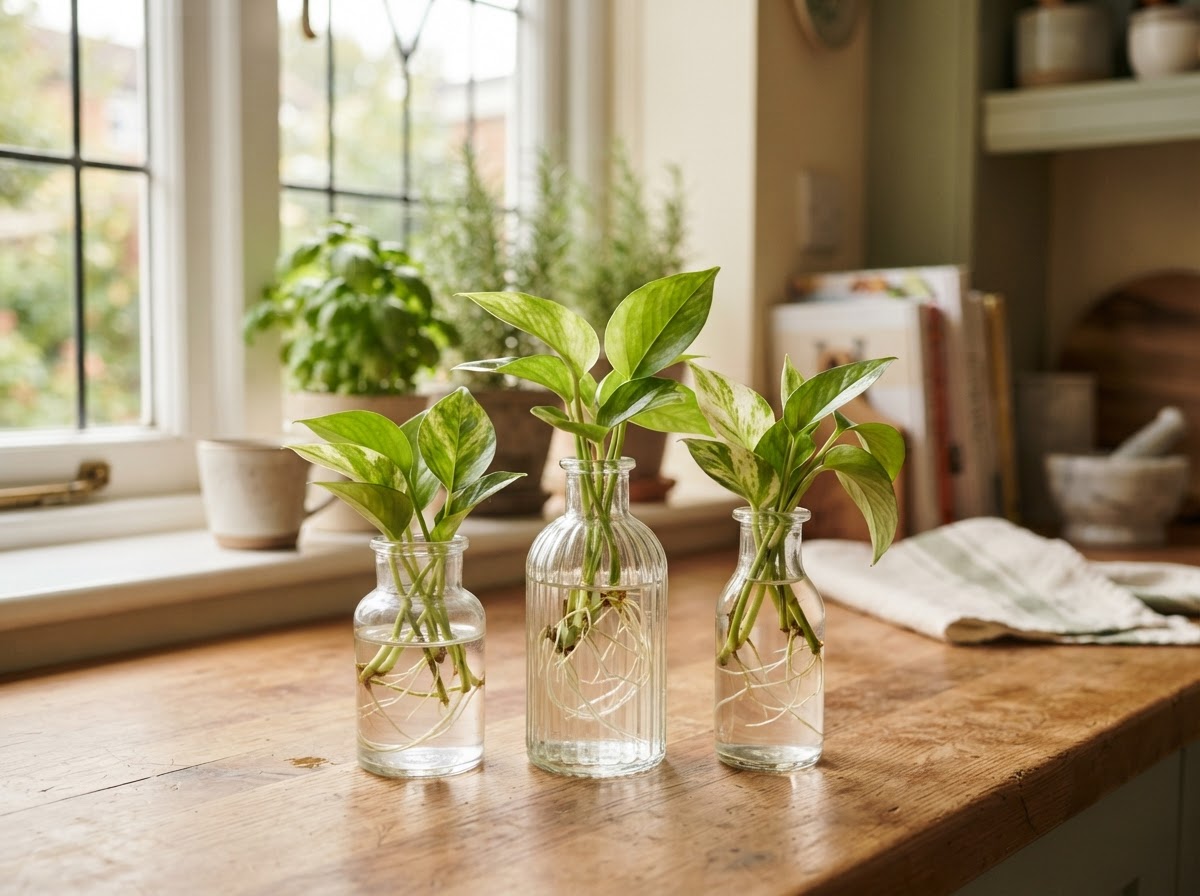
Three glass vases with pothos cuttings rooting in clear water on a sunlit kitchen counter

If this sounds familiar

You're in exactly the right place.

You've Googled "how to propagate pothos in water" and gotten forty contradicting answers. Rainwater only. Full sun. Change the water every three days. Never touch it. You read six different answers, trusted none of them, closed the tab, and did nothing — because when everyone is an expert and nobody agrees, the only safe move is to wait.

So you waited.

You've bought the cute plant. Brought it home from Trader Joe's feeling genuinely hopeful, set it on the windowsill, and watched it slowly decline for six weeks while you walked past it twice a day with that quiet, specific guilt you couldn't quite explain. You didn't make a big deal of throwing it away. You just quietly moved it to the trash one Tuesday morning and didn't mention it to anyone.

You've seen the aesthetic on Pinterest — the clean counter, the three glass vases, the visible roots trailing down through clear glass, the whole thing looking effortless and alive. You want exactly that in your home. But every YouTube video either assumes you already know what you're doing or spends twenty minutes on soil science you never asked for and will never remember.

You're not someone who can't keep plants alive. You're someone who has never had anyone just show you — clearly, specifically, without making you feel dumb for not already knowing.

That changes right now.

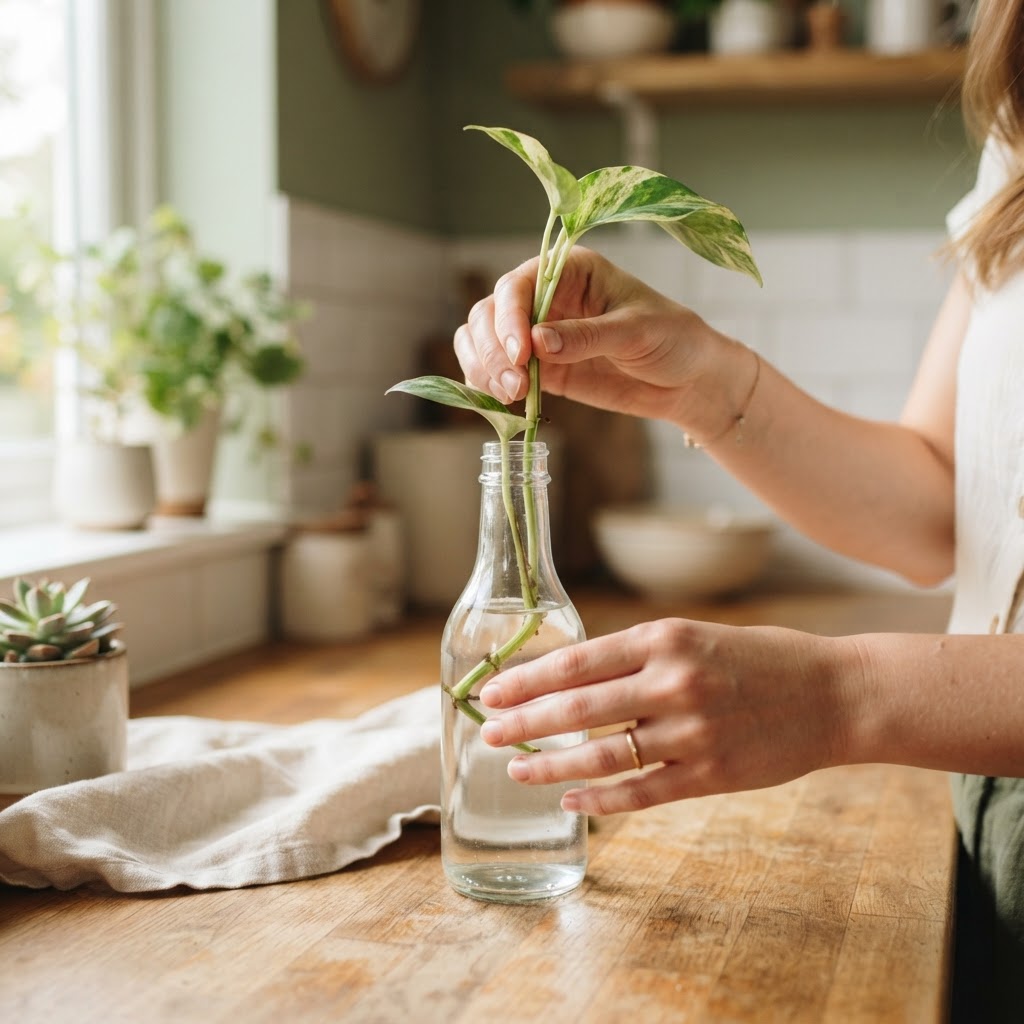
Hands placing a pothos cutting into a narrow-necked glass bottle of water

Here's what your kitchen could actually look like

Set it up this weekend. Wake up to it every morning after.

Picture a Tuesday morning — not a vacation day, just a regular Tuesday. You walk into your kitchen and there they are: two or three glass vases lined up on the counter, roots threading down through clear water, leaves catching the light.

You did that. You grew that. And it took maybe ten minutes and zero Googling.

You know which plants to buy now. You walk into Trader Joe's and instead of that familiar mix of wanting and hesitation — the "I'll probably kill it" voice — you feel something quieter. Certainty. You see a pothos and you know exactly what to do with it. You pick it up. You go home. You make a cut just below the node, drop it into the narrow-necked bottle you found at the thrift store for $1.50, and within a week you're watching something grow that you started yourself, from nothing.

And when someone walks into your kitchen and says "wait, did you do that yourself?" — you get to say yes. Not "I'm trying to" or "I don't really know what I'm doing." Just yes.

The guilt is gone. You know which plants actually thrive in water long-term. You're not guessing. You're not hoping. You're working with the right information for the first time.

This isn't a dream. This is what The 5-Plant Starter List was built for.

The real problem

The problem was never you. It was the information.

The internet has no shortage of water propagation content. What it has is forty contradicting answers, rabbit holes into soil science you never asked about, and YouTube videos that assume you already know the difference between a node and a leaf axil.

The 5-Plant Starter List is the one honest, consolidated answer.

It's a single page — the kind you tape inside a cabinet door or screenshot and keep on your phone — built specifically for the plant parent who just wants to know:

  • Which five plants to start with
  • What to put them in
  • Where to find beautiful glass without paying HomeGoods prices

That's it. No soil science. No horticulture credentials. No overwhelming system to learn before you can grow a single root.

See Ur Roots was built by someone who did the contradicting Googling so you don't have to. The angle is curation, not expertise. The right plants, the right vessels, the right timing — all in one place.

You've been ready to start. You just needed someone to hand you the list.

Free. No spam. Unsubscribe anytime. We'll never share your email.

What you get

One page. Everything you actually need.

The 5 fastest-rooting plants

The 5 Fastest-Rooting Plants for Water Propagation

Not every plant that can technically survive in water — the five that root fastest, thrive long-term, and look beautiful on a counter or bathroom shelf. Pothos. Tradescantia. Philodendron heartleaf. Sweet potato vine. Coleus. Each one: where to cut, what to expect, and how long until you see roots. You'll never stand in the plant section feeling uncertain again.

The vessel match guide

The Vessel Match Guide

The single most overlooked thing that makes a water propagation setup look styled instead of accidental is matching the mouth of the vessel to the stem thickness of the plant. This tells you exactly which vessel works for each of the five plants — so your arrangement looks intentional from day one, not like a happy accident.

3 places to find cheap glass

3 Specific Places to Find Cheap Glass That Photographs Like It Cost a Lot

The candle section at the thrift store. The dollar section at Target. Facebook Marketplace wedding lot sales. Concrete, specific, actionable — because you deserve to know that the propagation vase selling on Etsy for $18 has an identical twin in the pillar candle holder section of your local Goodwill for under $2. Nobody in the plant space is telling you this. This guide does.

Together, these three things give you everything you need to walk into a thrift store this weekend and have something thriving on your counter by next week — which is genuinely further than most people ever get.

About the creator

This wasn't built in a greenhouse.

It was built on a Tuesday morning in a kitchen that looked a lot like yours — standing in front of a dead pothos on the windowsill, coffee in hand, quietly calculating how many plants had quietly died on that same sill in the past two years.

The creator of See Ur Roots is not a plant expert. They'll tell you that directly, because that distinction is the entire point. They're a curator — someone who got so frustrated with the contradicting Google results, the YouTube rabbit holes, and the beautiful vessels that kept killing everything they put in them, that they decided to do the research once, consolidate everything that actually works, and share it in a way that finally makes sense for real plant parents living real lives.

"Their credentials are not botanical. They are lived."

They're the plant parent who impulse-bought a Trader Joe's plant and felt genuine guilt every time they walked past its slow decline. They're the one who spent real money on a HomeGoods vase only to discover, months later, that a two-dollar thrift store candle holder photographs identically. They're the one who pinned the clean counter, the glass vase, the visible roots — and then spent three years telling themselves they weren't a plant person instead of just starting.

What they discovered, once they finally put a pothos cutting in a narrow-necked bottle and watched roots appear in days, is that they had never been someone who lacked a green thumb. They had simply never been given one honest, start-to-finish answer.

They built See Ur Roots for the plant parent who has Googled "how to propagate plants in water" and gotten forty contradicting answers — and done nothing as a result. Because that paralysis is not laziness. It is a completely rational response to an overwhelming amount of conflicting information from sources that don't know your windowsill, your schedule, or your kitchen counter.

They're not here to turn you into a plant person in a way that takes over your life. They're here to hand you a glass vase and say — this is all you need.

Let your plants skinny dip. No soil required.

See Ur Roots logo

You've been ready to start.

You just needed someone to hand you the list. Here it is — the five plants, the right vessels, and the exact places to find glass that looks like it cost a lot. Free, one page, yours by this weekend.

Free. No spam. Unsubscribe anytime. We'll never share your email.